
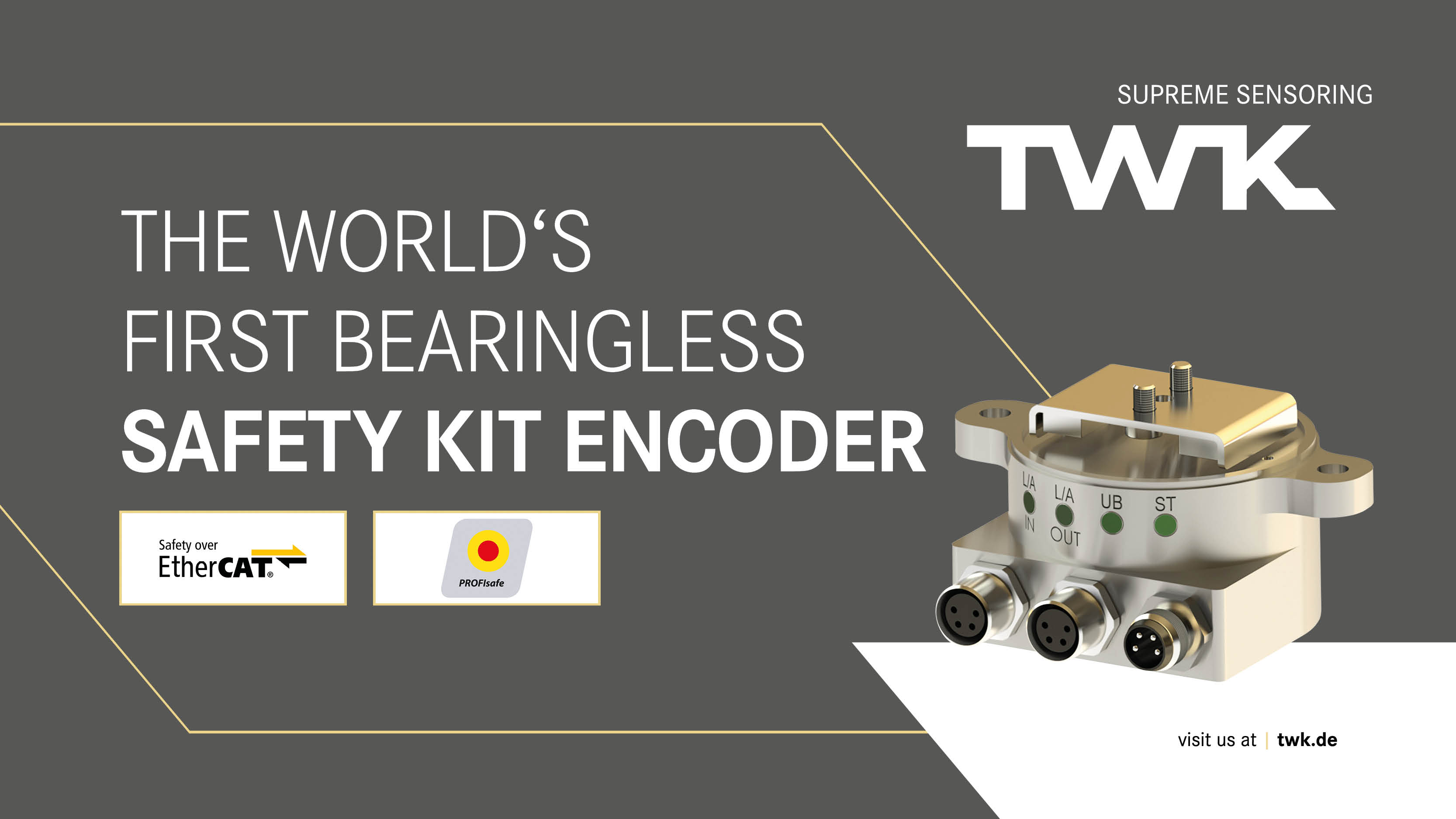
Many applications are designed to be as small and compact as possible, within the limits of their intended use. This conserves material resources as well as energy and manufacturing costs. Each component should take up as little space as possible, given its function. For this reason, we have expanded our line of bearingless encoders to include the world’s first safety-Kit Encoders with the Ethernet interfaces Safety over EtherCAT (FSoE) and PROFIsafe over PROFINET.
These new functionally safe devices, with a depth of just 25 mm and SIL2 / PLd certification, meet the growing demand for short or flat encoders. In most applications, there is little space between rotating parts and other mechanical components or boundaries. The encoder must fit into this small gap. This particularly applies to Automated Guided Vehicles (AGVs). AGVs are often required to be small, agile, and cost-effective. Our bearingless Kit Encoders enter a market segment where devices with shafts and associated bearings are too large or long, and hollow-shaft encoders are unsuitable.
We use the magnetic measurement principle, which eliminates the need for a fixed mechanical connection between the magnet and the sensor itself, thereby allowing for sealed housings made of aluminum, non-magnetic stainless steel, or plastic for the sensor and electronics. This enables a high protection rating of up to IP69K. The magnet itself is separate and also exhibits high resistance to adverse environmental conditions. Thanks to its special U-shaped design or, alternatively, through special magnetization in the case of the round magnet, it can achieve high accuracy values of up to 0.1% / 360° at a resolution of 16 bits. This is maintained even when the magnet is positioned several millimeters away from the sensor. Depending on the required accuracy, magnetic position tolerances apply regarding the magnet's distance, eccentricity, and tilt. The safety firmware detects the presence or absence of the magnet (“Magnet-Off Detection”). This is an important criterion for the system’s functional safety. Depending on the shaft and magnet design, the magnet can be mounted by screwing it onto the shaft or rotating part of the application or by gluing it in place. The encoder is then mounted directly in front of the magnet using a suitable mounting bracket to save space.
Despite the particularly compact design of the housing, which is only 25 mm thick and has a base diameter of 42 mm, the encoder models with FSoE or PROFIsafe interfaces are equipped with all functions as well as LEDs that display the operating status at all times and, in the event of a fault, the error code for service purposes. Electrical connection is made via three M8 connectors. The CANopen Safety variant with cable connection requires even less space, with a housing thickness ranging from 12 to 20 mm depending on the model. All versions output position and speed via the respective safety protocol. Upon request, they can be equipped with an electronic multiturn counter that reliably records the number of revolutions at all times. However, this is not possible when the system is powered off. Like their larger counterparts with a shaft and associated bearings, these encoders offer versatile parameterization options to adapt to specific applications.