
TTS NMF was founded as Neuenfelder Maschinenfabrik GmbH in Hamburg in 1970. Today, it is a leading manufacturer of ship cranes, focusing on heavy deck cranes. With lifting capacities (SWL) of up to 1000 t and 2000 t, the cranes manufactured here are the most powerful in the world when operated in tandem.
The fact that complex technology is used in these mighty systems is clearly revealed by the control technology, and particularly the sensor system that is implemented. Important parameters that have to be registered include e.g. the boom angle, the turret position (azimuth) and the winch speed for the lifting speed. The ship's heel (list) is additionally registered by means of an inclinometer. If the ship reaches a specific limit value when "rolling" around its longitudinal axis and a corresponding boom angle is registered, the function is limited due to safety reasons.
TWK has been supplying TTS NMF with sensors since 1986. Type PP27 potentiometric angle of rotation encoders were initially supplied. These encoders use contacts for sampling, and have a limited electrical working range. These small, robust rotary encoders that are suitable for industrial use were used primarily in smaller deck cranes to determine the distance between the load on the crane hook and the revolving crane (working radius). Type TBA50 contactless absolute rotary encoders are now increasingly being used.
The T series rotary encoders operate internally using HALL technology, i.e. magnetically. They are designed in dual-chamber technology which e.g. enables the electronics to be cast. The extended temperature range of -40°C to 85°C is standard. Thanks to its wall thickness of 5 – 10 mm, the housing, which is manufactured from aluminium or, in this case, stainless steel, is extremely robust. With a diameter of 12 mm, the stainless steel shaft can cope with loads of up to 250 N axially and radially. A Simmerring seal ensures leak tightness. Protection class IP69K can be achieved by casting the electronics in the housing. This encoder series is particularly suitable for harsh environments that are characterized by wet conditions and extreme temperatures.
It can be networked together with other sensor system and actuator system subscribers in e.g. a CANopen bus (Profibus, Profinet, etc.) using a bus interface. SIL2 and TÜV-certified variants are also available (CANopen Safety). In automating complex assemblies, these perform a number of tasks as position feedback sensors and speed sensors.
One further rotary encoder that has been developed specifically for cranes is an absolute multiturn encoder with slewing ring functionality. These enable the number of teeth of the slewing ring and rotary encoder pinion to be set directly in the rotary encoder. As a result, all conceivable gear ratios can be implemented, and the rotary encoder can be adapted precisely to the respective slewing ring by the customer. The rotary encoder then supplies the position of the slewing ring in degrees (resolution adjustable) and its speed in degrees/unit of time (unit of time adjustable) as output values. An optional play-free gear ZRS is available for coupling to the slewing ring. Manufactured from special, permanently elastic plastic, this gear is particularly resistant to temperature influences, moisture, aggressive substances and permanent mechanical stress. The special tooth shape guarantees that a tooth's flanks are constantly in contact with the gear that is to be measured. This prevents falsification of the measurement signal on switching between forwards and backwards rotation (backlash).
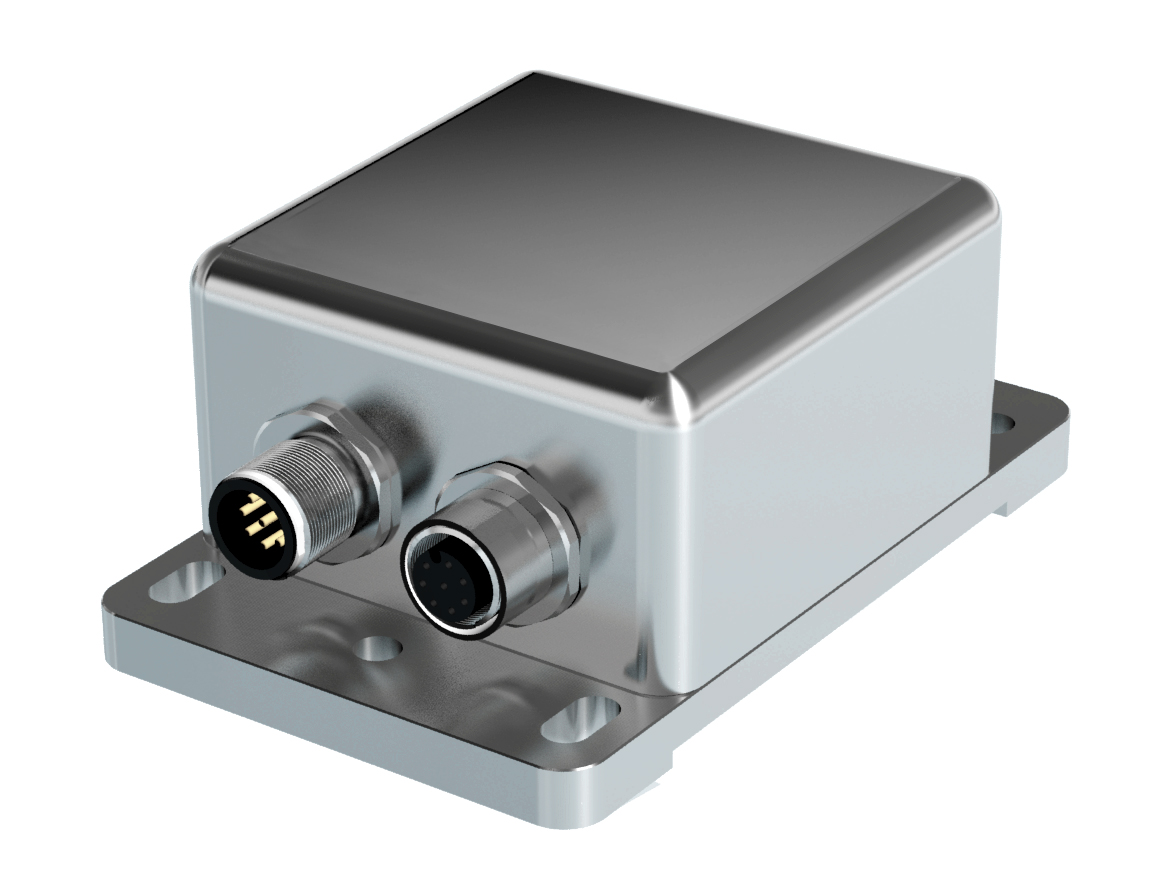
In the field of inclinometers, TWK has developed the NBx65 model series based on so-called MEMS technology. Registration over +/- 90° for one or two axes and signal output with all relevant industrial interfaces are possible. TÜV-certified safety variants are also available in this case. Thanks to the solid housing made of seawater-resistant aluminium or stainless steel, with wall thicknesses of up to 5 mm, these encoders are particularly suitable for maritime use.
Reliability, precision, a robust mechanical system and adapted software are the most important characteristics of the TWK sensors, ensuring that they are outstandingly suitable for use in harsh environmental conditions.